Case study
Back to projectsBoscof AI | Chatbot that amplifies a creator's voice
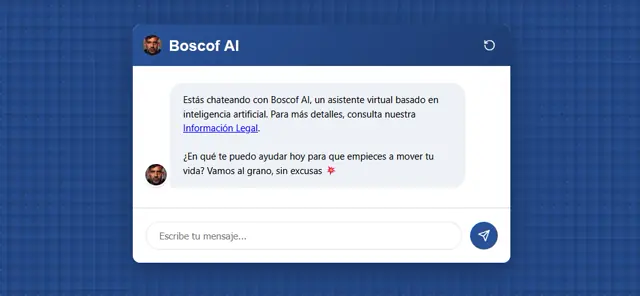
All of Álvaro Boscof's knowledge poured into an AI. A tool for his community to access his philosophy anytime, anywhere.
Starting point
The project before the code
Context
Álvaro Boscof is a personal development and mindset creator with over 1 million followers. The project started as a personal idea and ended up becoming a direct collaboration with him.
Goal
Build a chatbot able to answer questions in Boscof's own style, tone and philosophy, so his community could access his knowledge without him needing to be present in every interaction.
It all started with a Python script
I’d been following Álvaro Boscof for a while: one of the most well-known personal development and mindset creators in Spanish, with over 1 million followers. One day I remembered I had a Python script that transcribed YouTube videos and audio files. I ran it, transcribed all his public videos, and used that material to create a custom GPT trained on his content.
The idea was just for me. I wanted to be able to ask Boscof things without having to dig through dozens of videos to find where he’d said it.
What happened next
I sent him the GPT. He replied shortly after: he’d been thinking for a while about creating a chatbot that talked like him, and he wanted to know if I could build it.
I said yes. Being completely honest, at that point I didn’t know exactly where to start.
A month of research and problem-solving
What followed was a month of real work: researching, testing, breaking things, starting over. Every problem that came up, I worked through it as it appeared. No clear roadmap, no guarantee it would work out.
The result was a chatbot capable of answering questions in Boscof’s tone, style and philosophy, trained on all his public content. A tool that doesn’t just automate responses — it maintains his way of thinking and communicating. His knowledge available 24/7, without him needing to be present in every conversation.
What I take away
This project taught me that the best projects sometimes aren’t planned: they just happen. And that saying yes when you don’t fully know how to do something — if you have curiosity and persistence — almost always works out.
What changed
Lessons learned
A personal project with no intention of showing it can open doors you didn't expect. Sometimes the most valuable thing is what you build for yourself.
Not knowing how to start something isn't a reason not to try. Research and persistence end up solving almost any technical problem.
AI doesn't replace a creator's essence, it amplifies it. That was the hypothesis and the result confirmed it.